The Reviews
Bachmann 31-476 G2 No 9449
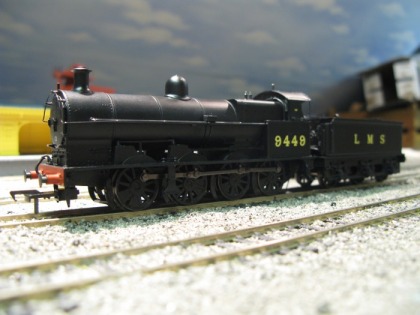
After receiving my pay from Kernow today, I managed to buy a couple of things, and I decided to treat myself-one of the new Super D's.
First things first, packaging. The loco is packed in Bachmann's new style of boxs. Some dislike them due to the amount of space wasted, but I like it-much more simple to remove than the older packaging, less chance of breaking that one detail that makes or breaks the loco. She's an impressive beast, a slightly unusual sight compared to all the larger 4-6-0/4-6-2 abd 0-6-0 tender engine's we're used to. Detail is amazing, paticularly the opening smokebox door that Bachmann is including on all their new toolings. However, don't look inside-there is no detail inside. Despite this, I love the feature-look out for it in future Camborne Parkway videos. You do have to glue the guard irons and vacuum pipes on though.
I gave the engine the usual running in on DC, where she proved to be a quiet and smooth runner. I then decided to install DCC. No instructions are included as to how to take the tender body off. Underneath the tender, there are three main screws-two silver ones at the back, and a black one near the front. DO NOT UNDO THE BLACK ONE FULLY! This is the screw that allows you to ajust the loco and tender distance. Only undo the two silver screws at the back to tke the tender body off. I took all three screws out, which meant half an hour scrabling around undoing everything trying to put the black screw back in. Those using 8-pin Hornby decoders will need to purchase a 21-8 pin adapter to allow the decoder to plug in.
When she started running on Camborne Parkway, she proved to be a smooth and quiet machine, whilst also being storng, handling a six coach train with ease. The loco with an open smokebox door looks fabulous at the shed area, maybe I'll have to buy a pack of cleaner figures to pose inside the smokebox. The engine only has six pick ups on the loco, but it still managed to pass over my straight of points with no problems at very slow speed. She can even manage first radius-just.
This has proven to be a fine little loco, adding another of those 'mddle of the range' locos missing from most layouts, and the first example of an LNWR loco in RTR. I'll give it 8.5/10-Bachmann need to sort out instructions as to how to remove the tender body, but that's only a small niggle in the long term.
Hornby R2665 and R2783: 0-4-0's
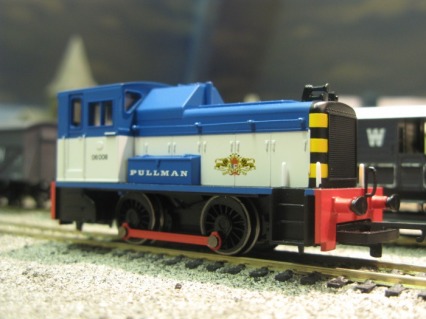
Got these through the post thanks to the 'free gift' offer when Hornby realised I hadn't renewed my Hornby Collector's Club Magazine thing, a Blue Pullman shunter, and a 101 class 328. And then I thought that it was a bit weird that in all my travels of the web, I had NEVER seen a review of a Hornby 0-4-0. Well, here we go...
The historical bit-first up, the Class 06. This class of 10 locomotives was built for use on the Scottish Region of BR, by Andrew Barclay. Only one locomotive still survives-06003, currently owned by Harry Needle Railroad Company. The GWR 101, on the other hand, has no survivors. There was only one built at Swindon, in 1902, the only 0-4-0T built there in standard gauge. It's possible that the loco never even left Swindon, and it was withdrawn in 1911.
First off, the packaging. These models still use the boxs with holes in the back, which normally annoys me, but as these are older less detailed models, with no fine details to break, it's OK this time. Looking at the models themselves, the paint finish is up to the usual high standards of Hornby. Which helps to distract from the lack of detail compared to modern models. The 101 has moulded hand rails, whilst the Class 06 only has non-moulded handrails down the side of the body. Unsuprising really, as the mouldings are extremlly old-I remember seeing the 06 in a late 80's catalouge! Does anybody know when these moulds were created? Onto a slightly more 'rivet counter' point, sorry about this, but both chassis use the same chassis-one or both bodies must be inaccurate for the chassis. But who cares about that!?
Performance. The two models were run as analouge engines on my Select unit. Both started at a high speed, no slow crawling motors here. Also, both stalled on some of my points, and neither could haul a 5 coach train without slipping, although the 101 was a lot more slippy than the 06, which is also very slightly slower. The 0-4-0 chassis doesn't exactly look a joy to convert to DCC either, with lots of soldering around the chassis according to the Hornby DCC fitting guide.
So, the models are not the best runners, haulers, or detailed. Normally, this would result in a very low mark. But...
THEY'RE SO MUCH FUN!
Honestly, could you really ignore these two for long? They're such a joy to run around the layout, and the wide array of liveries mean you're not likely to come across two that are exactly the same. However I have-I've already got the 101, but I've found some replacement number plates-lovely cheap project! 8.5 or 9/10-fun on four wheels!
ViTrains Class 37/4
The Historical Bit
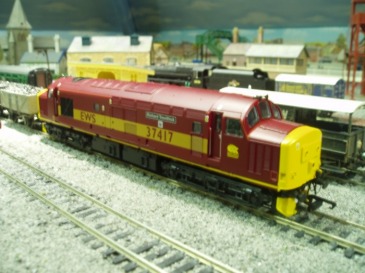
The British Rail Class 37 was built between 1960-1965 as a new locomotive intended to haul both heavy freight and passenger trains, the latter resulting in the Western Region trying to modify the class for 100mph running. Their low axle loading and power have resulted in some examples still being in use today. The 37/4 sub-class was the batch that were fitted with Electric Train Heating (ETH) in the 1980s, and it is this sub-class that my model represents.
The Model
Looks
Comparing my model to a photo of the real 37417 I found on the internet, ViTrains seem to have captured the look and feel of the locomotive really well. There are only two little things I have spotted in the comparison-the first is that the horns on the real things are lower than on the model, though I probably haven't pushed them in far enough, and on my model, underneath the nameplate is a small plate featuring the first railway locomotive in the world, the Pen-y-darren. Unfortunatly, this can't be seen on the real locomotive, but maybe my model is of 37417 as she was a couple of years ago or something. This are small little things, however, that in my opinion, do not detract from the whole feel of the model. Detail is extrodinary-I promise never to call diesels plain-old-boxes-on-wheels again! However, you have to fit most of the bufferbeam detail yourself, as well as the snowplows, lamp irons (I think that's what they're called) and pipes on the nose of the locomotive. If you're a fine modeller, this will not be a problem, but if you are like me, with all the skills of a rotting boxing glove, then this will take time, and a reasonable amount of glue. If all of this is fitted, then it prevents the loco going round corners with coaches properly. In theory. Detail that you don't fit is fantastic, with my favorite being the fan in the roof. However, unlike recent Hornby models I have heard about, the fan doesn't move. Pity.
Performance
First off, haulage power. And all I can say is excellent! The loco is very heavy, which provides plenty of traction, and it shows-the model is able to start a 11 coach train on a curved point with absolutly no problems whatsoever. The weighty chassis also means the locomotive doesn't exactly derail easily. Pointwork facing the wrong way proved no problem for this beast, unlike some smaller locomotives. Points do not present a problem power-wise either. 'Richard Trevithick' was able to pass over my long line of 6 points at a crawl with no stalling or stopping. Electrical pick-ups are visable on 8 of the 12 wheels, and it all works splendidly. The motor is quiet, but when audible, sounds lovely. I almost wich it was louder, as to my ears, it sounds a fair bit like a diesel.
Features
Really, all this model has is directional lighting and an 8-pin decoder socket. Word of advise, if you're going to install a decoder, do it before you install the pipes on the nose, they go down under the buffers and back again, which meant for me hurridly pulling them out again hoping I hadn't damaged my lovely model. Instead of a DCC blanking pin, ViTrains have instaled two small bits of metal that do the same job, but they're a real pain to get out! Still, there's plenty of room for a decoder. As for the lighting, this can be switched on and off by the decoder when not needed. However, I had a lot of fun driving this loco about in the dark, constantly changing direction to watch the lights switch over. During the day, the lighting looks fine, if a little bright, but at night, there is some slight light bleeding through the grills on the nose due to the white. The red lights do not suffer this problem-in fact these look perfect. If only the white lights shone at the same level as the red lights. Overall, though, the lights seem fine to me.
Conclusion
Although there have been a few small problems along the way, overall the locomotive is a brilliant peice of engineering. It represents the Class 37's well, in terms of both performance and looks. I would reccomend one of these locos to anyone who needs one. I'm giving it... 8.5/10.
